

THAI MASSAGE

The hands came before the gongs

Before sound there was bodywork, and before bodywork there was Chiang Mai. I trained in Northern style Thai massage in Thailand across several years, mostly at the home of one teacher. I do not offer sessions now. This is where that part of the history lives.

WHAT IT IS

What a Thai massage actually involves

It looks less like a massage than most people expect, and it feels like being moved rather than being rubbed.

There are no oils and no lotions, though a balm gets used on a particular area to bring some warmth into it. You stay clothed. It happens on a mat on the floor rather than on a table, which is the first thing people notice, and it changes what is possible: I can use my feet, my forearms, my elbows and my own body weight, and I can move you into positions a table would not allow.

There is contact almost the whole way through, but the body is compressed, pulled, stretched and rocked rather than rubbed. The work follows the sen, the energy lines, and it starts at the feet and legs and spends a long time there before going anywhere else. A full session runs two hours or more.

Where it comes from

Thai massage is sometimes called Thai yoga massage, and the resemblance is real: assisted postures, pressure along lines, principles that came across from Indian Ayurveda. Thai tradition names Jivaka Kumar Bhacca as the father of its medicine, an Ayurvedic doctor born in India during the Buddha’s lifetime who is still revered in Thailand today.

That is the account the tradition gives of itself, and I pass it on as that rather than as history I can vouch for.

HOW I LEARNED

Being told my technique was terrible

I studied in Phoenix first, with a few teachers, workshops and the occasional private lesson, and it never felt complete. It was all technique and manoeuvres. So I went to Chiang Mai, and my first two weeks at the Old Medicine Hospital reinforced exactly what I already had: palm pressing, thumbing, forearms, elbows, a client moved through a handful of positions, and a final exam where you perform a sequence several hours long and are graded on whether you hit the points correctly.

I still did not feel ready to give a Thai massage. I remember thinking that it could not all be about a sequence, and how thin that would be if going through the motions were enough. Plenty of the people I trained with there never went on to practise.

The first day at Hang Dong

Then I found myself at Ajahn Pichest Boonthumme’s house in Hang Dong, and on my first day he told me my technique was terrible. Two days earlier, teachers at the Old Medicine Hospital had told me it was perfect. I believed Pichest, because inside I felt the same.

He watched me work on somebody and told me the sweat on my forehead was not a good sign, that I was working far too hard. He told me my body was terrible too, that I had been practising too much yoga and was inflamed from it, and that I should take an anti-inflammatory. He tried to correct my hands physically and then gave up.

That was the first day I needed. He was taking apart whatever ego I had built around this, and it worked. I broke down in tears that night, and underneath it there was relief, because I could finally admit that I knew nothing about Thai massage. The pieces of paper and the years of study in my spare time were hollow, because I had not learned to feel with my heart, or to work without the analytical mind running, or to understand my own body.

Going back the next day

I gave up my daily ashtanga practice. I took the anti-inflammatory. And I went back to his house every day expecting to be broken down again. Pichest was not a conventional teacher and a lot of people did not last long there. Learning from him meant unlearning things that are difficult to put down. The commute out to his house carried excitement and dread in the same measure: whether today was the day he worked on you, or the day you watched him bring somebody else to tears.

I spent three months in Thailand across three trips that first year, most of it at his house. In between I opened a small studio in Phoenix and started giving sessions, and every one of them raised the same question the house did, which is whether this is the person who shows me I know nothing again.

What he was actually teaching

No sequence and no technique gets you there. You have to be willing to put down what you know and let the body in front of you lead. In the quiet part of a session, when you stop steering, each body tells you what it wants. I have often found myself drawn to an area without knowing why. Call it intuition or sensing or feeling. That is where the work happens, in the unknowing.

On one of my last trips he asked me to give him a massage, and he slept through most of it. Every student of his hopes for that: the point where your teacher stops teaching and just receives. I used things in that session I had never used before and have not used since.

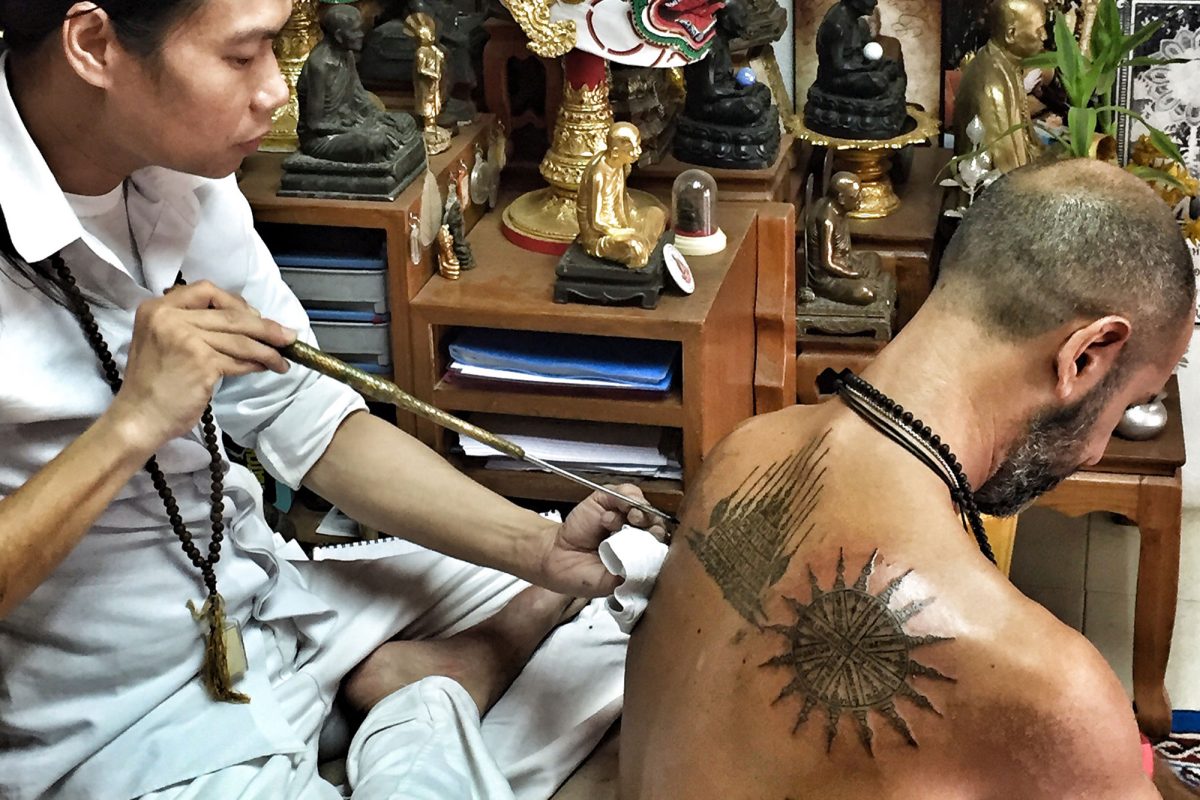
A Thai master tattooing a sak yant on Hamid's back with a traditional rod, in a room full of Buddha figures
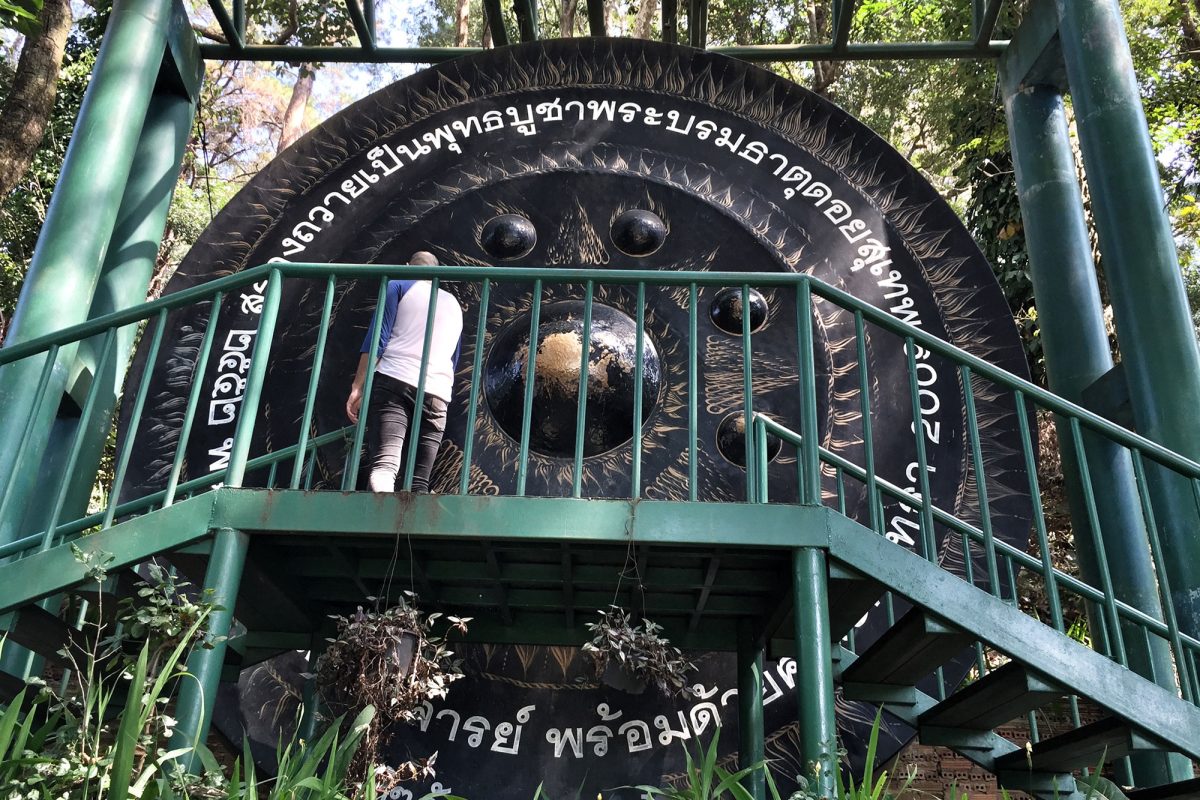
A large temple gong on a raised platform in Thailand, its face covered in Thai lettering
NORTHERN FOLK STYLE

Why what I learned is not the Royal style

Parlours advertise a Royal Thai massage and it is worth knowing what that means. Royal style was performed on the royal family, and out of respect for the king it uses a deliberately narrow set of techniques: no standing on anybody, no feet, no elbows, and the recipient stays on their back or their side rather than face down. It is barely practised in Thailand now, because it was built for one client.

What I learned from Pichest is the Northern folk style, the style of ordinary people, and it has none of those limits. Feet, elbows and body weight are all tools, and the body can be moved into whatever position the work asks for. It is the fuller thing, and to my mind the more useful one.

I do not offer Thai massage sessions, in Phoenix or anywhere else, and have not for some years. Sound is the work now, and it lives on the rest of this site.

“It is a conversation, and no two conversations are ever exactly the same.”
HAMID
THE REST OF THE HISTORY

The rest of this history

Learning it in Thailand

Why learning this the way I learned it is nothing like taking a course, and what going to Chiang Mai actually involves.

Tok Sen

A northern practice worked with a wooden mallet, and the one part of this that is not done with hands.

Pichest's style

Why my teacher rebuilt the practice so that it benefits the person giving it as much as the person receiving it.

Plant medicines

The other half of the history, and where it meets this one: ayahuasca, huachuma, and the work I still do in Peru.

Contact Me

I will respond quickly to all inquiries submitted via this website. All fields required.

Follow & Connect with Me