
For practitioners already working with sound. Two weekends in person at my place in New River, four integration calls after them, and a practicum you design. Capped at eight people.
Two weekends in person, four integration calls afterwards, and a two hour practicum of your own.
Small enough that the work is about what you already play rather than about the syllabus.
This assumes a foundation. Level I here, or equivalent training somewhere else.
At my place, about fifty minutes north of downtown Phoenix.
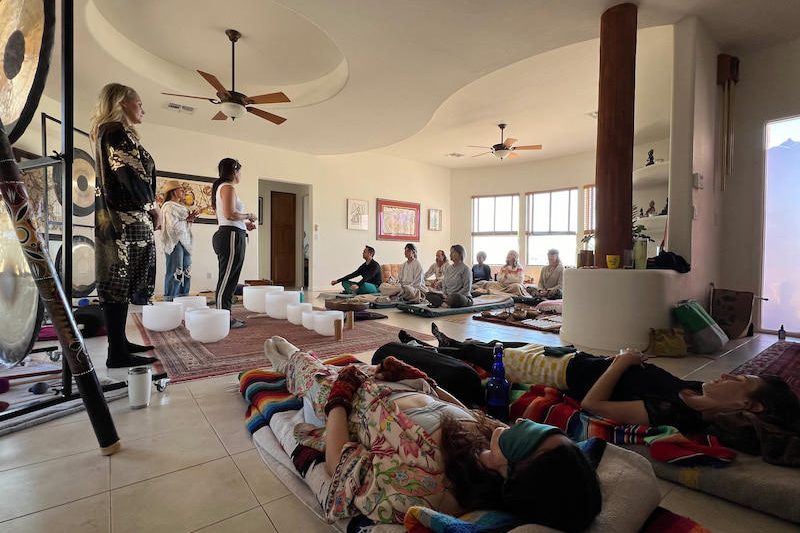
Graduates of Level I used to ask when the Level II was. I would joke that Level II is learning how to load the car with all the instruments, and then I would tell them the real answer, which is that most of Level II is going out and doing it. Practising, refining, listening, learning to hold a room.
That was true and it was not the whole answer. I kept working on a curriculum I believed in, and after about seven years of giving people the same reply it became a real training in 2025.
It goes deep and it asks for experience. If you are not yet running sessions for other people, this is not the one to take first.
Graduates of Level I, and practitioners who trained somewhere else and have been holding sessions for a while. What we do here assumes you can already play the instruments, so the time goes on everything after that.
If you have not trained with me there is a twenty hour online course that covers the ground Level I does.
Anybody already working with people has had to decide what to call this, and the decision is worth making on purpose. Read the red flags
Five areas, and a sixth that the group in the room decides.
Advanced gong and bowl technique, where playing less gets you more. Nuanced mallet work, extended friction mallet technique, vocal range and presence, the overtone flute, and the quiet end of the collection: artisanal bells, rattles, chakapas, shakers.
Building layers and textures that carry people somewhere, rather than playing one instrument after another. The crossing from sound work into music, harmonic theory at the keyboard and harmonium, and weaving in wind, ocean and rain.
Guiding a meditation with a script and without one until it sounds like you. Holding space with real boundaries, the power of the silence between sounds, and designing a session around a theme rather than around a playlist.
Cultural context and appropriation, honoring where these instruments come from while finding your own expression. New instruments and where the field is going. How to run this as something that sustains itself.
How sound meets non ordinary states, what is measurable about this work and what is not, helping people process and ground what came up, and sound as something that catalyses rather than only relaxes.
Every cohort turns up with its own questions and its own curiosities, and those become part of the curriculum. Eight people is small enough to follow them.
If bowls are what you are adding, the long version of how they are made and what separates a good one is written out here. Read what a crystal bowl is
All the instruments are here. By Level II most people arrive with their own as well, and we work on what you actually play. If you are looking to add something, I will help you choose.
Four integration calls run after the in person weekends, once the material has had somewhere to land. That is deliberate. Most of what is hard about this work turns up the first few times you do it on your own.
There is also a two hour practicum, designed with you rather than handed to you. It might be teaching a class, writing or research, or running an offering of your own that uses sound. We agree what it is together.
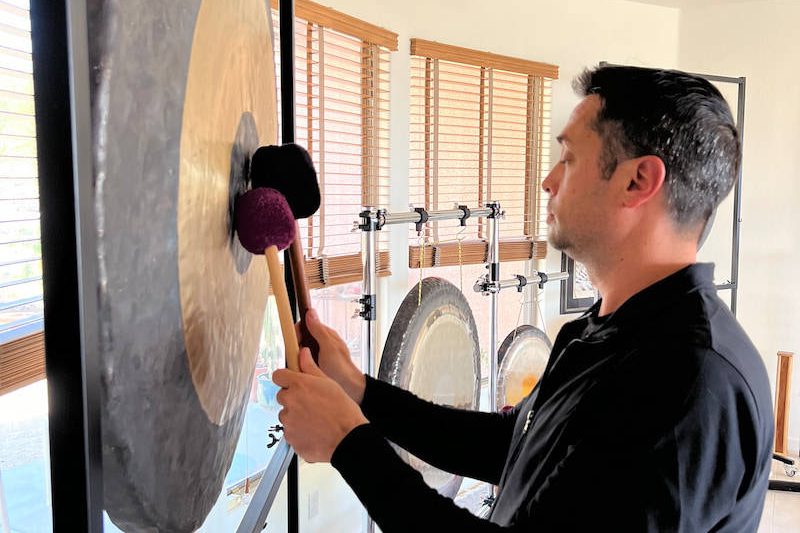
Dates go on the events page as they are set. Tuition covers all materials, and a deposit holds a place. Each run is priced when it is scheduled, and the figures are confirmed in writing before anybody pays.
The deposit is non refundable. Training is held at a private residence in New River, about fifty minutes north of downtown Phoenix and about an hour from most of the Phoenix area. Finishing carries a certificate of completion and Yoga Alliance continuing education hours, for anyone who needs the documentation for a studio or a venue. Places tend to go early, so it is worth asking before a date is announced.
Beyond Gong is its own weekend rather than a run of Level II. The gong technique is the advanced work and the room is a wider one, so the playing happens alongside people who came up through Level I, with cymatics, song circles and the newest instruments in the field. Two days of real playing time is the part of this training people say they want more of, and this is where it is on the calendar.
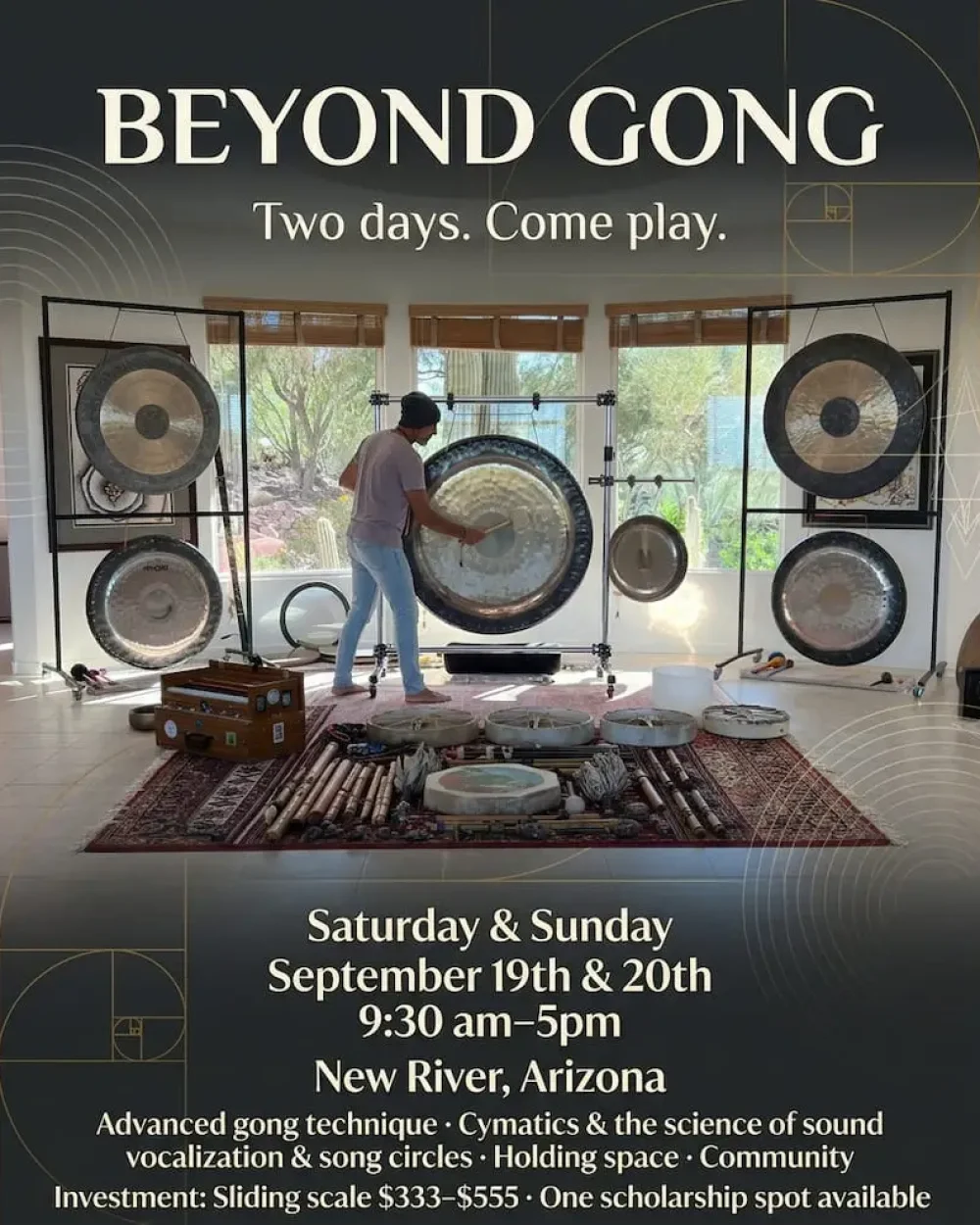
Saturday and Sunday, September 19 and 20. 9:30am to 5:00pm both days. My place in New River. Sliding scale, $333, $444 or $555.
Two days of playing together, built around the gong and the power of overtones. I will be teaching advanced gong playing throughout, in a way meant to be accessible to everyone in the room, and around that there is a song circle, cymatics, time with the newest instruments in the field, and the kind of conversation about sound that practitioners rarely get to have with each other. Eight places, and my online sound course comes with every one of them, so it is open to beginners and to people who have been playing for years.
If you are not running sessions for other people yet, Level I is the way in. Thirty two hours across two weekends, hands on the whole time, and everything here is built on top of it.
The online course covers the theory at your own speed, and Sound Mentorship is the one to ask about if what you want is shaped around you rather than around a cohort.