

TOK SEN

Tapping the lines with a wooden mallet

A northern Thai practice worked with a mallet and a peg instead of hands. I learned it in Hang Dong from Ajahn Lee, and I do not offer sessions. This is what it is, what the tools are, and what it feels like.

WHAT IT IS

Tapping, and what is being tapped

Tok Sen is unlike enough to other bodywork that most people’s first reaction is confusion. Somebody is being hit with a hammer and a chisel, and it is meant to feel good.

The name means tapping the sen. In Thailand the sen are the energy lines that run through the body, and the whole of Thai massage follows them. Anybody who has spent time with yoga or Ayurveda knows them as nadi, and three of the main sen are the same as three of the main nadi. Past the spine the two systems stop agreeing, and Chinese medicine’s meridians are a third map again. They resemble each other. They are not the same, and it is worth not flattening them.

In ordinary Thai massage the sen get worked by compression. Sitting on somebody, walking on them, pressing with hands, feet, thumbs, elbows and forearms. Warm the body first, then work deeply along the lines to free whatever has stopped moving. Tok Sen does the same job with tools, and the tools reach in a way hands cannot: a tap carries through the tissue in a way that pressure does not.

It is not the lazy man's yoga

Thai massage gets called that, and the name has never been deserved. Thai massage is not yoga, and stretching is not the point of it. I have received Thai massage from all kinds of practitioners in Thailand, and being stretched was the exception rather than the rule. Most of those sessions had no assisted postures in them at all.

THE TOOLS

A mallet, a peg, and a tree that was struck by lightning

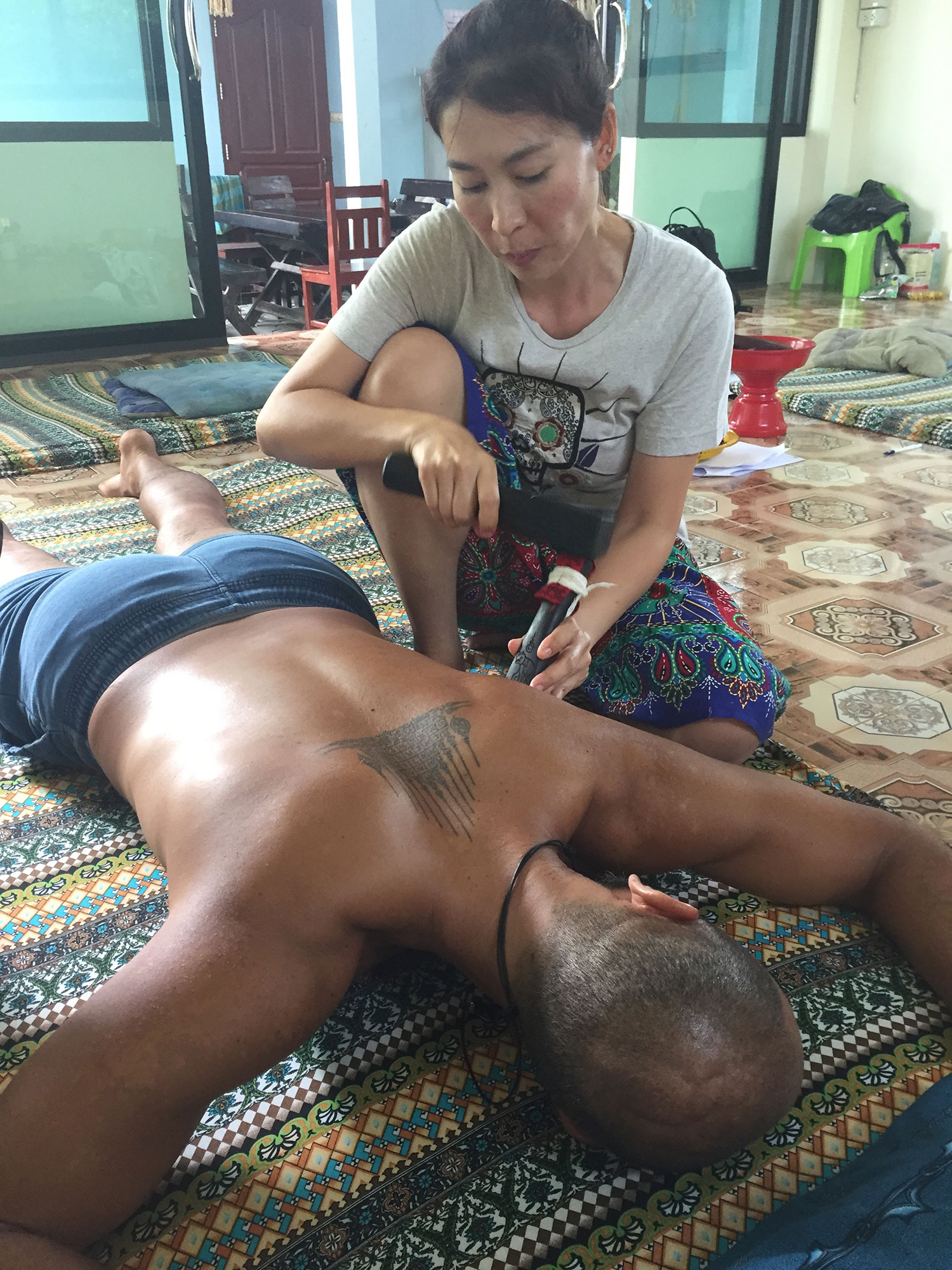
A standard set is two pieces: a mallet, which is the hammer, and a peg, which is the chisel. The peg is what does the work along the sen. The mallet supplies the vibration. There are a lot of ways to hold and move them and most of the skill is there rather than in the striking.

The good sets are made from a particular tree that grows in northern Thailand, and the tradition is that the tree has to have been struck by lightning. That is what I was taught and I pass it on as that. The wood is hard to find now. A set is engraved and then blessed in a long ceremony, and it gets sesame oil regularly to keep the wood from cracking.

The two sets I own

One of mine is a real set, from the rare wood, engraved and blessed by Pichest. Sets like that are difficult to find and expensive when you do, perhaps 3,500 baht in Thailand. The other cost about 280 baht and is what I use on myself: ordinary wood, no lightning, and a thin rubber sleeve on the mallet so the sound is softer.

Getting an authentic set in the United States is close to impossible. What is sold online is mostly poor quality wood at prices that bear no relation to what the thing is.

A SESSION

What actually happens for two hours

A full Tok Sen massage runs up to two hours. It starts with the person face down or face up, on a Thai mat on the floor or on a table, whichever they would rather. The lines get tapped from the top down, with the most time spent wherever the most has stopped moving. Once each side is done they may be asked to lie on their side or sit up, which opens the sen that cannot be reached any other way.

Balms and creams get used on bare skin so the peg can slide. Done properly it causes no pain and leaves no bruising, which surprises people who have watched it before they have felt it. It can also be worked into an ordinary Thai massage wherever an area wants more than hands are giving it.

The tapping is doing two things

The obvious one is mechanical. The tapping frees the flow of lom along the sen much as hands do, and in western terms you could describe it as working on fascia.

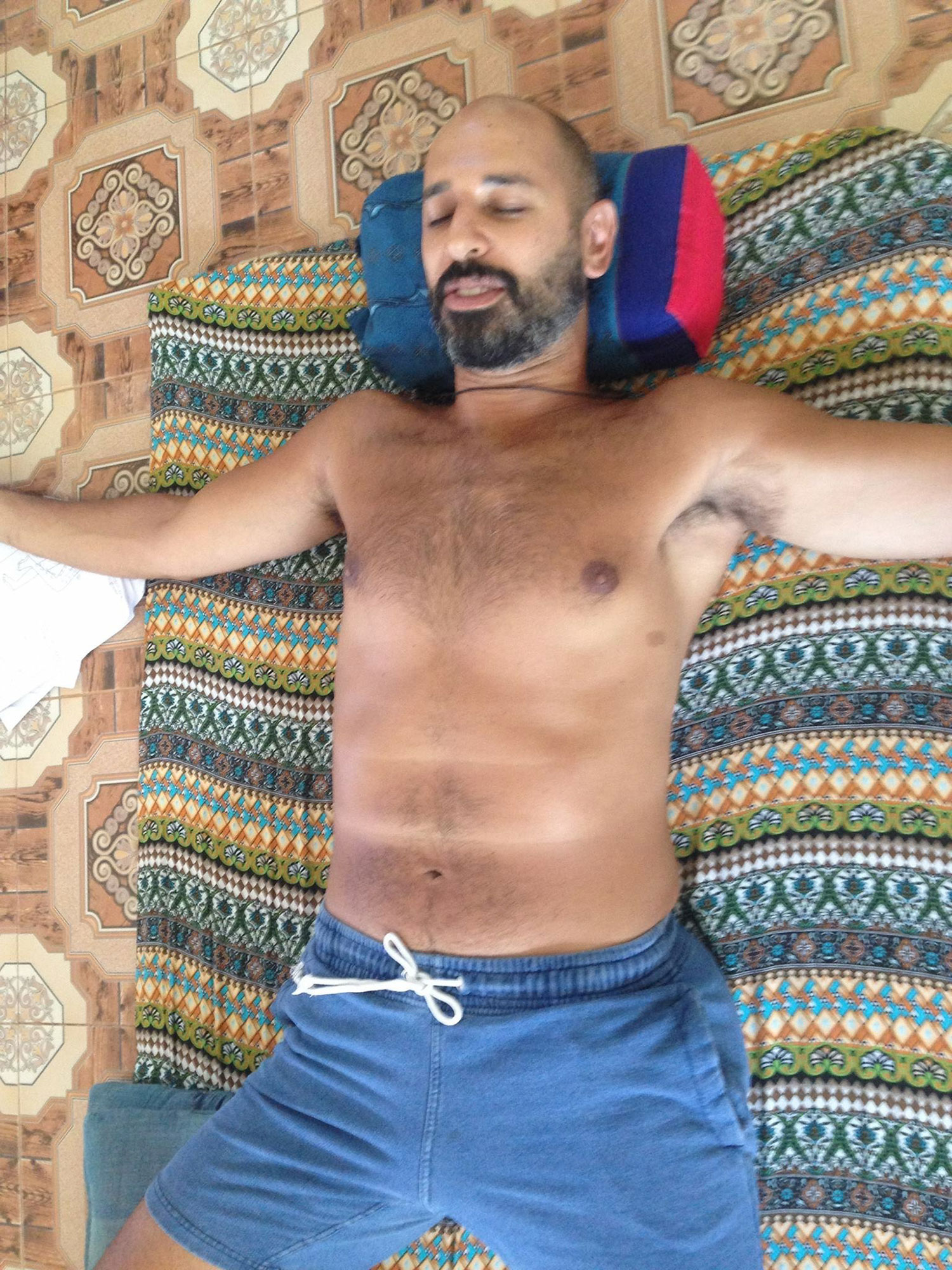
The other one is sound. The rhythm is steady and the mallet on the peg is a real note, and people drop into deep relaxation under it or fall asleep outright. In Thailand that is understood as part of the treatment rather than a side effect of it. This is the earliest place the two halves of my work meet: years before I stood behind a gong, I was watching somebody go under from rhythm alone.

Ajahn Lee working the back lines, filmed at Hang Dong. The sound in it is the point as much as the movement.

I do not offer Tok Sen or Thai massage sessions, in Phoenix or anywhere else. Sound is the work now, and it lives on the rest of this site.

Ajahn Lee tapping along Hamid's back with a Tok Sen mallet and peg as he lies face down on a Thai mat
Hamid asleep on a Thai mat during a Tok Sen treatment in Thailand, his head on a folded bolster
“The rhythm is doing as much of the work as the pressure is.”
HAMID
THE REST OF THE HISTORY

The rest of this history

Thai massage

How I got to Chiang Mai, what the practice actually is, and where it sits in the rest of the history.

Learning it in Thailand

Why learning this the way I learned it is nothing like taking a course, and what going to Chiang Mai actually involves.

Pichest's style

Why my teacher rebuilt the practice so that it benefits the person giving it as much as the person receiving it.

Plant medicines

The other half of the history, and where it meets this one: ayahuasca, huachuma, and the work I still do in Peru.

Contact Me

I will respond quickly to all inquiries submitted via this website. All fields required.

Follow & Connect with Me