
GUITARS

Matsuoka guitars, and the fifty dollar one

One of them I bought deliberately. The other I found for fifty dollars at a garage sale, played all the way through music school, and turned down fifteen hundred for. The same man signed them both.

THE ONE THAT MATTERS

A garage sale in Texas

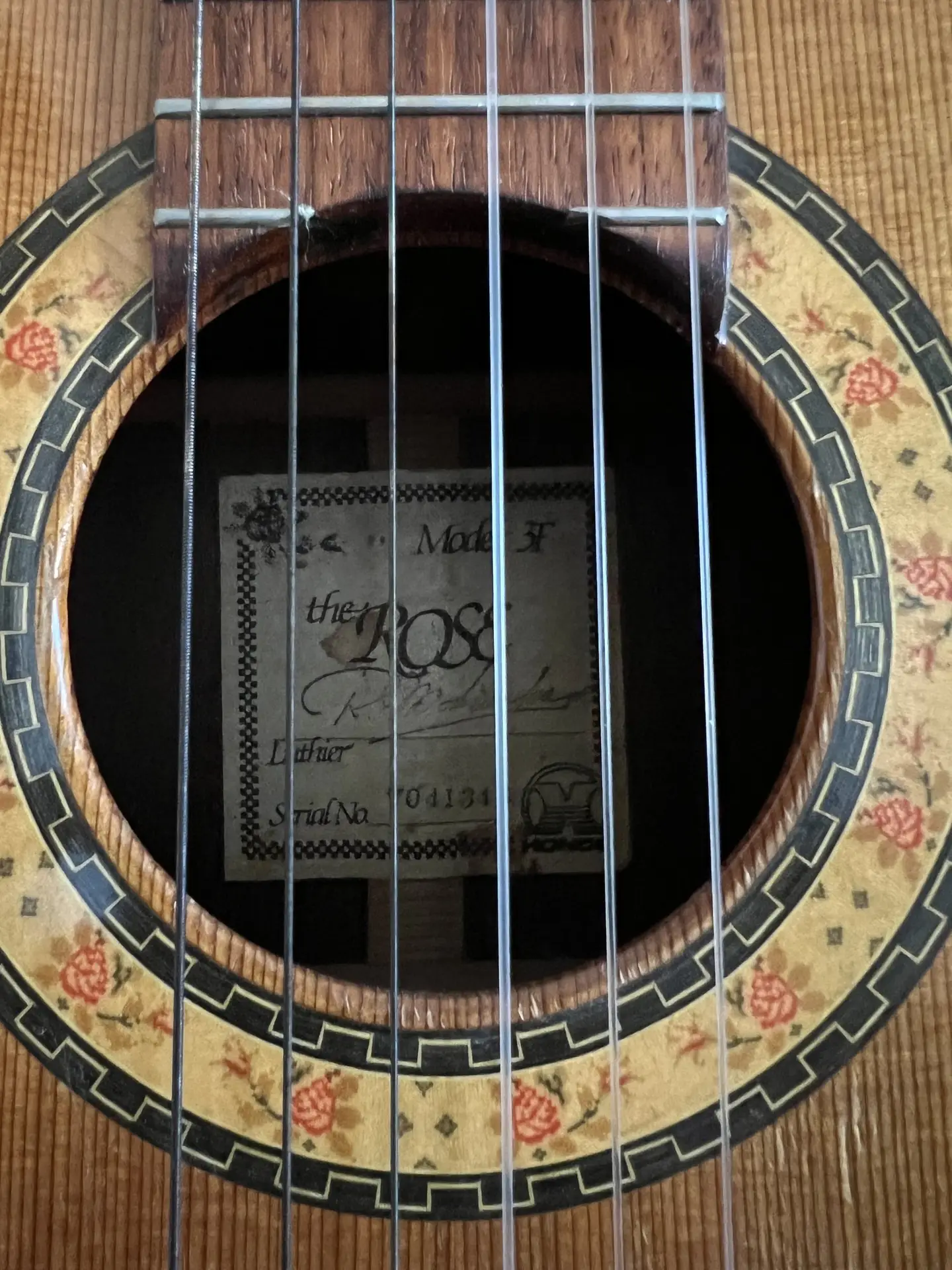
The soundhole of a classical guitar, its rosette painted with red roses, and inside a paper label reading the Rose, signed R. Matsuoka on the luthier line, with a Hondo logo in the corner

I found it in the 1980s on a table in somebody’s driveway in Texas, and I paid fifty dollars for it. The label inside says The Rose, and it came through Hondo, a Fort Worth company that put its name on instruments built for it elsewhere.

It went to New York with me and it was the guitar I played through my Bachelor of Music at NYU. Every practice room, every jury, four years of the hardest listening I have ever done, on a guitar that cost less than a set of strings and a case.

What my teacher offered for it

Around 2000 my classical teacher offered me fifteen hundred dollars for it. He had been sitting across a music stand from that guitar for years and he knew exactly what he was hearing.

I said no. Then I told him I had paid fifty dollars for it at a garage sale, which I enjoyed a great deal more than the offer.

That exchange is the reason this page exists. An instrument gets valued twice, once by whoever priced it and once by whoever hears it, and those two numbers have almost nothing to do with each other.

Who built it

It is a Matsuoka, and the label says so in his own hand. The printing is a fine script inside a woven border with a rose in the corner, the Rose set at twice the size of anything else, and under it a form: Model, Luthier, Serial No. Model 3F and the serial are stamped in. Across the Luthier line, written large and freely, is the signature. R. Matsuoka, in the same hand that is printed on the M30’s label a few feet away in the same room.

In the corner beside the serial is Hondo’s own logo, so both facts are on the one piece of paper: the workshop that built it and the company that sold it.

Which is a fact nobody has written down

Hondo was International Music Corporation of Fort Worth, set up in 1969 with the Korean maker Samick. Its Japanese suppliers are recorded as Tokai and Matsumoku. No published source I can find puts Matsuoka among them, and no published source mentions a guitar called the Rose at all.

So the label in this guitar is better evidence than anything written about the subject, and it says something the record does not know: Ryoji Matsuoka signed instruments that went out under Hondo’s name in Texas. If you own one of these, that signature across the Luthier line is the thing to look for, and it is worth turning the guitar to the light for.

The rosette is painted with roses, which is where the name comes from, and I have looked at it across the top of that guitar for forty years without once thinking to read what was written underneath it.

THE DOCUMENTED ONE

What a Matsuoka label tells you

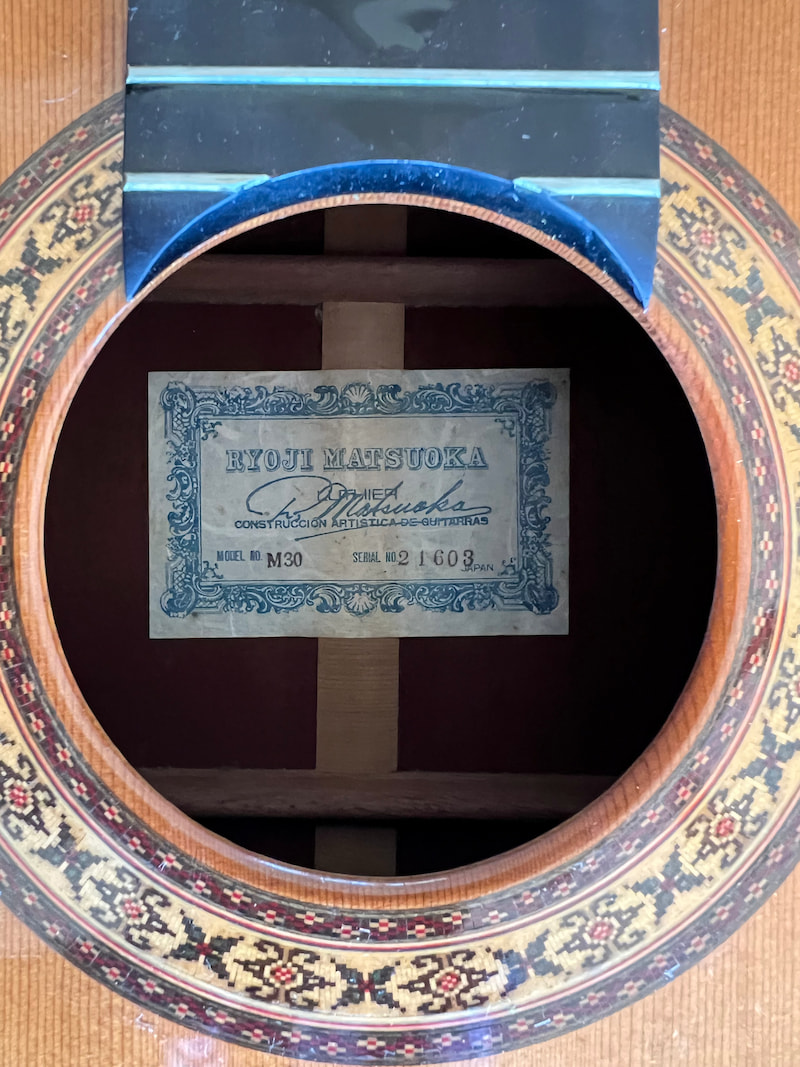
The other one is an M30 and everything about it is legible. The label reads Ryoji Matsuoka, then a printed signature, then Construccion Artistica de Guitarras, then the model, then the serial number 21603, then the word Japan.

The Spanish is worth a moment. Matsuoka was working in Nagoya, building guitars that borrowed the Ramirez headstock, and he put Spanish on the label because Spain was where the authority in this instrument sat. A great many Japanese classical guitars of those decades did some version of the same thing, and it tells you what the makers thought they were competing with.

Blue label

Sellers describe a label like this one as a blue label. It describes the blue engraved border and the blue printing on cream parchment, which is a dating clue rather than a series or a grade. Reading it as a specification is a mistake worth avoiding when a listing leans on the phrase.

The M30 sits in the middle of the range: a solid top, laminated rosewood back and sides, a mahogany neck. It is a good guitar and it is not a rare one. I would rather own an honest middle of the range instrument than a story, and the M30 is exactly what it says it is, which after the garage sale guitar is restful.

The paper label inside a Ryoji Matsuoka guitar, seen through the soundhole, printed in blue on cream with an ornate border and reading model M30 and serial number 21603
THE MAKER

Nagoya, and what happened to the name

Ryoji Matsuoka built in Nagoya from the 1960s. Before his own name went on anything he was making the upper models for Shiro Arai at Aria, sometimes with his own label inside and sometimes with nothing but that RM stamp on the neck block, which is why the stamp is worth knowing about if you are looking at an unbadged Japanese guitar.

The numbering runs in two eras and listings confuse them constantly. The early guitars are plain numbers, No. 20 up through No. 200. The M prefix arrives later, with MH marking a Hauser headstock against the Ramirez one. Around the turn of the 1980s the range ran all laminate at the bottom, solid tops through the middle, and all solid woods at the top.

The workshop closed with him

He died in September 2014 and the Nagoya workshop went with him. Guitars are still sold under the name and they are made in China now, which is a different proposition from one with a Nagoya label inside it. Anybody shopping by the name alone should know which of the two they are being offered.

There is also a Masaru Matsuoka, a different maker entirely. Read the first name on the label before anything else.

FOR SCALE

The rest of what I play

A judgement about an instrument is worth what it was measured against, so here is what the fifty dollar guitar sits next to in this house.

Raimundo

A model 155 from the Valencia workshop, bought around 2019, and signed on the label by both father and son. Raimundo have been a family firm outside Valencia for generations and they still finish by hand.

La Patrie

The top of the line model from the Quebec workshop, solid cedar over solid rosewood. Godin has since folded the brand into its own nylon series, so the name inside mine is already retired.

Cordoba C7

The travel guitar. A solid top over rosewood, seven fan Torres bracing, and a guitar I can put in an overhead locker without thinking about it for the rest of the flight.

“The best guitar I own cost fifty dollars, and the only thing wrong with it is that I cannot prove who made it.”
HAMID
ELSEWHERE

Most of what I play now has no strings on it

Gongs and singing bowls took over a long time ago and they are what the rest of this site is about. The guitars are still in the house, and the fifty dollar one is still the one I reach for.