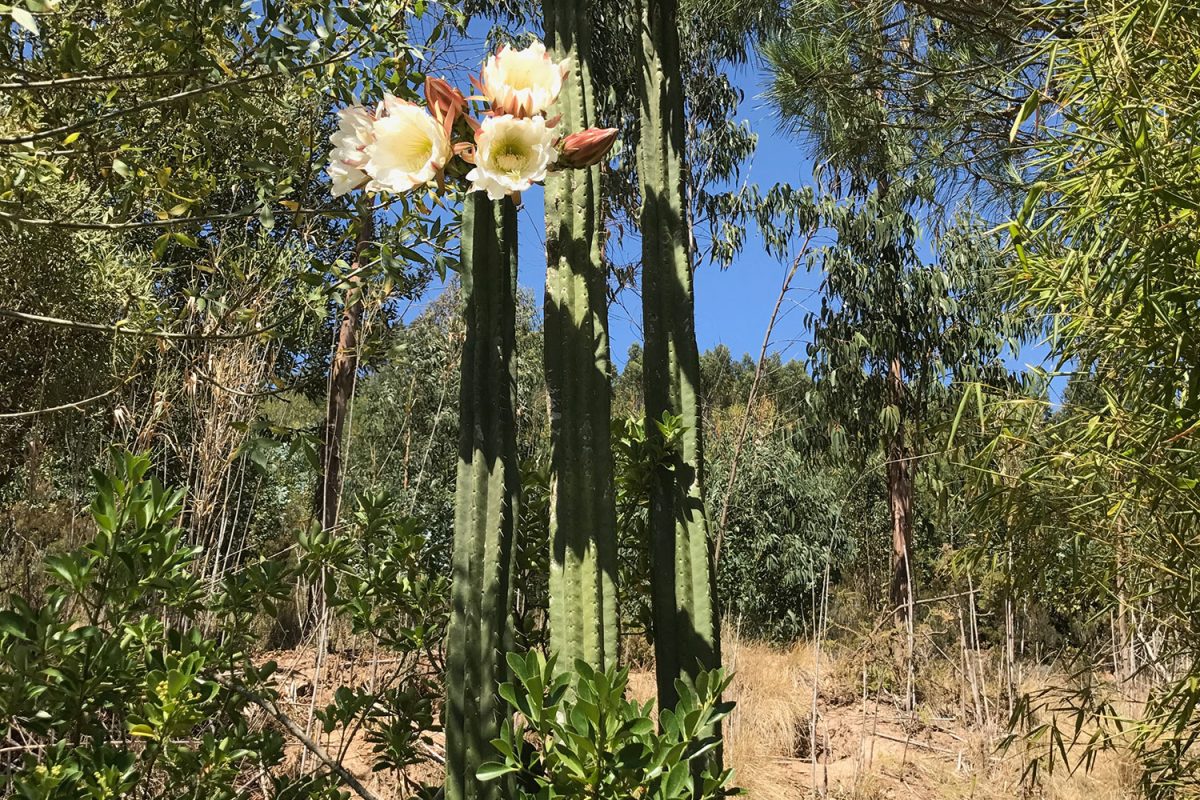
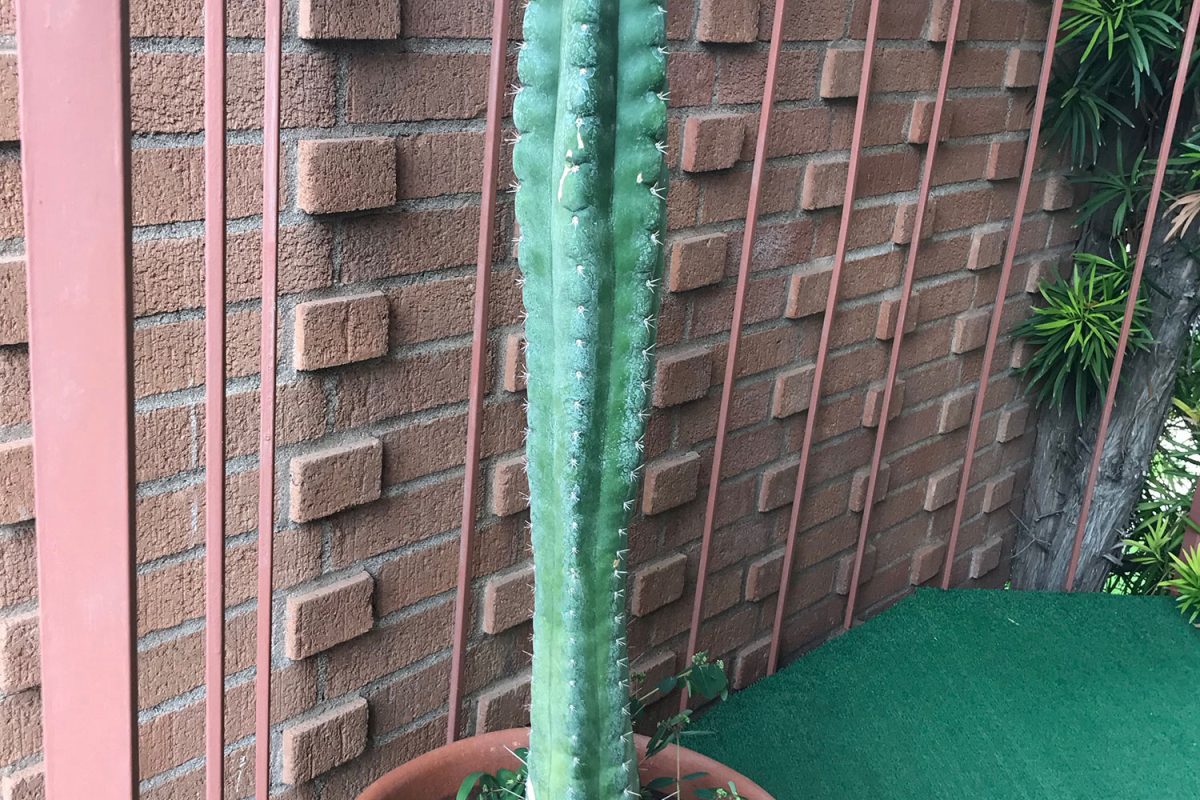
This is the detail that surprises people most, and it is true in a great many American backyards.
Huachuma is a cactus native to the Peruvian highlands, and various strains of it have been grown as ornamental garden plants in the United States for decades. It is sold in nurseries. People inherit it with a house. Somebody reading this almost certainly walks past one every week without a second look.
Botanically it is a group of closely related species gathered under Trichocereus pachanoi, which some now classify as Echinopsis pachanoi. The forms range from thin, nearly spineless columns in the lowland deserts to thick, long spined varieties higher up in the Andes.
Where the name came from
Huachuma is the older name. It has been called San Pedro since the time of the conquistadors, and the usual explanation is that they understood what they were seeing as opening the gates of heaven, and so named it after the saint who holds the keys. That is the story as it is told rather than documented history, and I pass it on as that.
THE CEREMONY
A whole day, usually outside, usually sociable
Huachuma is worked with both at night and during the day, and daytime is much the more common. A day ceremony starts in the morning and runs on, because the effects last more than twelve hours. That length is the practical fact that shapes everything else: it has to be prepared for properly, and there has to be time afterwards.
Ceremonies usually involve sound, stated intentions or prayers, and being out in a landscape. Compared with an ayahuasca night they are social. People talk to each other. Night ceremonies are a different thing again, often around a fire, much more internal, and closer in feel to the ayahuasca ceremonies described on the other page.
What people describe
The word that comes up most is vibrational. People describe feeling vibration moving through the body, and sensing it in things that are not obviously vibrating, from rocks to fruit to the ground. Sound in particular is often described as unusually vivid, felt in the body as much as heard, and sometimes seen as light behind closed eyes. That is the point where this half of my history and the sound work most obviously touch.
Ordinary perception shifts rather than disappears. Full open eyed visions are uncommon. What is common is seeing one thing as another, a mountainside reading as a face, an animal carrying the likeness of somebody who has died. The traditions that work with this do not treat those as hallucinations. They treat them as seeing something that was already there, or as a reflection.
The eyesight reports, which nobody has explained
There is a persistent report, and I have heard it many times, that vision improves and stays improved after daytime ceremonies. It is anecdotal, there is no mechanism offered for it that I would repeat as fact, and I am including it because it is what people say rather than because I can account for it.
WHAT IT IS WORKED WITH FOR
A heart medicine, in the words of the people who use it
In the traditions that hold it, huachuma is spoken of as a medicine of the heart, and worked with in a setting that has been prepared rather than casually. The experience is often described as everything being amplified, though the people I have learned from would put it the other way around: that nothing is amplified and something is taken away, and what is removed is the filtering that normally sits between a person and what is in front of them.
What people describe afterwards tends to be about clarity rather than revelation. A sense of what matters to them, held separately from the story they usually tell about themselves. A connection to the place they were in, and to the people they were with.
“A day of it outdoors is not a stronger version of anything. It is a different question being asked.”
HAMID
THE REST OF THE HISTORY
The rest of this history
Where this fits
How I came to these traditions, what these pages are for, and what they deliberately are not.